
A film treatment is a prose document that tells the story of a film from beginning to end in the present tense, written before or instead of a full screenplay. It reads like a short story with almost no dialogue — usually a few pages long — and shows a reader the characters, the main sequences, the tone and the ending.
Treatments are used to pitch a project, to win a writing assignment, to apply for development funding and, privately, to test a story before committing to a hundred pages of script. Writers are often asked for one after a producer likes a logline and wants to know whether the whole story holds up.
What is a treatment in film?
In film, a treatment is the middle step between the pitch and the script: longer and more vivid than a synopsis, shorter and less detailed than a screenplay. It covers the full story in prose, organized by act or sequence, and conveys how the film will feel to watch.
The word is used loosely. One producer may call a two-page document a treatment; another expects twenty pages with occasional lines of dialogue, sometimes called a scriptment. Documentary treatments describe the subject, access, approach and visual style rather than a plot. When someone asks for a treatment, ask what length and purpose they have in mind.
Treatment vs synopsis vs outline
A treatment, a synopsis and an outline all describe a story before the script, but each is written for a different reader and job.
- Synopsis: half a page to a page summarizing the plot and the ending. See how to write a synopsis.
- Treatment: several pages of narrative prose, with key scenes, tone and character, written to be read and enjoyed by someone outside the project.
- Outline or step outline: a working list of scenes or beats, written for the writer rather than an outside reader.
- Screenplay: the full script, scene by scene, with dialogue, in screenplay format.
How long is a film treatment?
A film treatment for a feature is usually somewhere between 2 and 15 pages, and many working treatments land at a few pages to about ten. Short treatments sell a concept; longer ones, sometimes 30 pages or more, are written when a producer wants the whole story worked out before a draft is commissioned.
There is no fixed rule. The right length is the shortest one that tells the full story with its tone intact. For a short film, one or two pages is usually enough.
What goes in a film treatment
Film treatment template (PDF)The five parts with a prompt for each — free, no sign-up
Film treatment template (plain text)Paste into Google Docs, Word or Scenaloom's outline
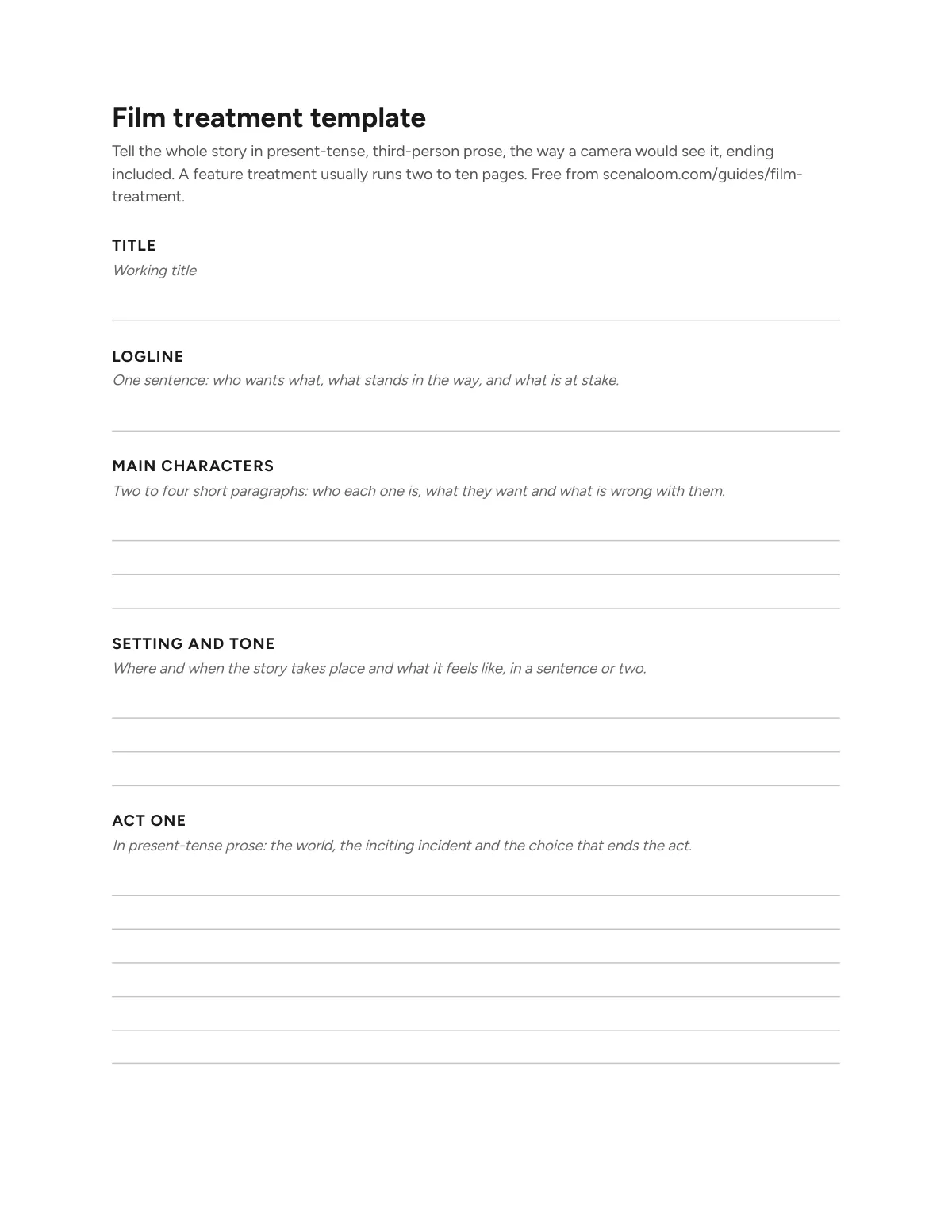
- Title and logline: the working title and a one-sentence summary at the top. See how to write a logline.
- Main characters: a short paragraph on each of the two to four major characters — who they are, what they want and what is wrong with them.
- Setting and tone: where and when the story takes place and what it feels like, in a sentence or two rather than a lecture.
- The story, act by act: the bulk of the document, told in present-tense prose, with the key scenes given room to breathe.
- The ending, always. A treatment that withholds its ending cannot be evaluated.
Some treatments add a short statement of theme or a note on why the writer is the right person to write the film, especially in funding applications. If the person asking gives you a format, follow it.
How to write a treatment
To write a treatment, start from a working logline and beat sheet, then tell the story in present-tense, third-person prose, giving the most space to the scenes that change the story and describing what the audience sees and hears.
- Lock the structure first. Know your inciting incident, act breaks, midpoint and climax; a beat sheet is a good starting point.
- Write in the present tense: "June unties the ferry", not "June untied the ferry" — the same convention as a screenplay.
- Write visually. Describe what a camera could see and a microphone could hear, rather than what characters privately think.
- Dramatize the key scenes. Give each turning point its own paragraph and summarize the connecting material in a sentence.
- Use dialogue rarely. One or two lines can capture a voice, but a treatment is not a script.
- Carry the film's tone in the prose. A horror treatment should be unsettling to read; a comedy treatment should make the reader smile.
- Introduce each major character in capitals on first appearance, with an age or a defining trait.
Film treatment example
This short treatment is original and written for this guide. It would serve a short film of about twelve to fifteen minutes.
The Last Crossing
Logline: A night ferry pilot who has never missed a crossing must decide whether to break the rules when a stranger with no ticket says she has to reach the far shore before dawn.
JUNE OKAFOR (50s) has piloted the last ferry across Hollow Lake for twenty years. She is precise, proud and alone; her logbook is the closest thing she has to a companion. Tonight the lake is fogged in, and the harbor master orders all crossings stopped.
As June ties up, TESS (20s) runs down the jetty in a wedding guest's dress and muddy trainers. She has no ticket and no explanation, only that she has to be across before sunrise. June refuses. Tess sits down on the jetty and does not leave.
Over an hour of standoff, the two talk around the edges of the truth. June learns that Tess's brother is getting married on the far shore at dawn, and that Tess walked out of their mother's funeral two years ago and has not spoken to him since. Tess learns that June once missed a crossing — the one night her own sister needed her.
June unties the ferry. The crossing is slow and blind; the radio crackles with the harbor master's warnings until June switches it off. Halfway across, the engine stalls. In the silence they hear bells from the far shore. June and Tess row the last stretch with the emergency oars.
At first light, Tess steps onto the jetty and runs toward the bells. June stays at the wheel, opens her logbook and, for the first time in twenty years, writes nothing at all.
The example tells the whole story in under 300 words, reveals the characters through what they do, gives each turning point its own paragraph and ends on an image rather than an explanation.
Common treatment mistakes
- Writing a sales pitch instead of a story — adjectives about how exciting the film will be in place of events.
- Character backstory that never reaches the plot.
- Camera directions. Describe what we see, not how it is shot.
- Too much dialogue. If the treatment is turning into a script, write the script — see how to write a screenplay.
- Leaving out the ending.
Write it in Scenaloom
In Scenaloom, each project's outline is rich text, so a treatment can be drafted beside the beats board and the scene board that will become the script. Worldview — the story bible — keeps the logline and character notes that Scenaloom AI reads when you ask it for help, and outlines and beat sheets can be exported along with the script. See outline and beats or start a project.
Questions
What is a film treatment?
A film treatment is a prose summary of a film's whole story, written in the present tense, that sits between a short synopsis and a full screenplay. It describes the main characters, the key scenes, the tone and the ending in a few readable pages, and is used to pitch a project or plan a script before writing it.
How long should a film treatment be?
A feature film treatment is usually between 2 and 15 pages, with many working treatments running a few pages to about ten. Some development treatments run to 30 pages or more. A short film treatment is typically one or two pages. If a producer or fund specifies a length, follow it exactly.
Does a film treatment include dialogue?
A film treatment includes little or no dialogue. It tells the story in descriptive prose, and a line or two of dialogue may appear only where it captures a character's voice or a key moment. If a treatment starts to fill up with dialogue, it is usually a sign that the writer is ready to start the script.
What is the difference between a treatment and a synopsis?
A synopsis is a short summary of the plot, usually one page or less, that covers the main turns and the ending. A treatment is longer — several pages — and tells the story more vividly, scene by scene, conveying tone and character as well as events. Both reveal the ending. See how to write a synopsis.
Do you need a treatment before writing a screenplay?
No, a treatment is not required before writing a screenplay, and many writers go straight from an outline or beat sheet to a draft. A treatment is useful when someone asks for one, when you need funding or approval before writing, or when you want to test whether a story holds together before committing to a full script.