Screenplay format is the fixed page layout used for film and TV scripts: 12-point Courier on US Letter paper, a 1.5-inch left margin and a set indent for each element — scene heading, action, character, parenthetical, dialogue and transition. Because the layout never changes, one formatted page runs roughly one minute of screen time.
This guide covers how to format a screenplay from the page up: paper and margins, each element with its position and casing, spacing, page breaks, scene numbers, the page-per-minute rule and the difference between a spec script and a shooting script. An annotated example page sits in the middle and the most common mistakes come at the end.
Page setup: paper, font and margins
Movie script format starts with the frame every reader expects. Set the page once and every element falls into place inside it:
- Paper: US Letter, 8.5 by 11 inches.
- Font: Courier at 12 points, or a close cousin such as Courier Prime, which prints exactly 10 characters per inch and 6 lines per inch. The screenplay font guide explains why nothing else will do.
- Margins: 1.5 inches on the left (the extra half inch leaves room for binding brads) and about 1 inch at the right, top and bottom.
- Line length: 6 inches of text, which is 60 characters of Courier.
- Lines per page: about 55, counting the blank lines between elements.
- Page numbers: top right, followed by a period ("2."), starting on the second page. The first page of the script carries no number, and the title page is not counted at all.
The elements of screenplay format
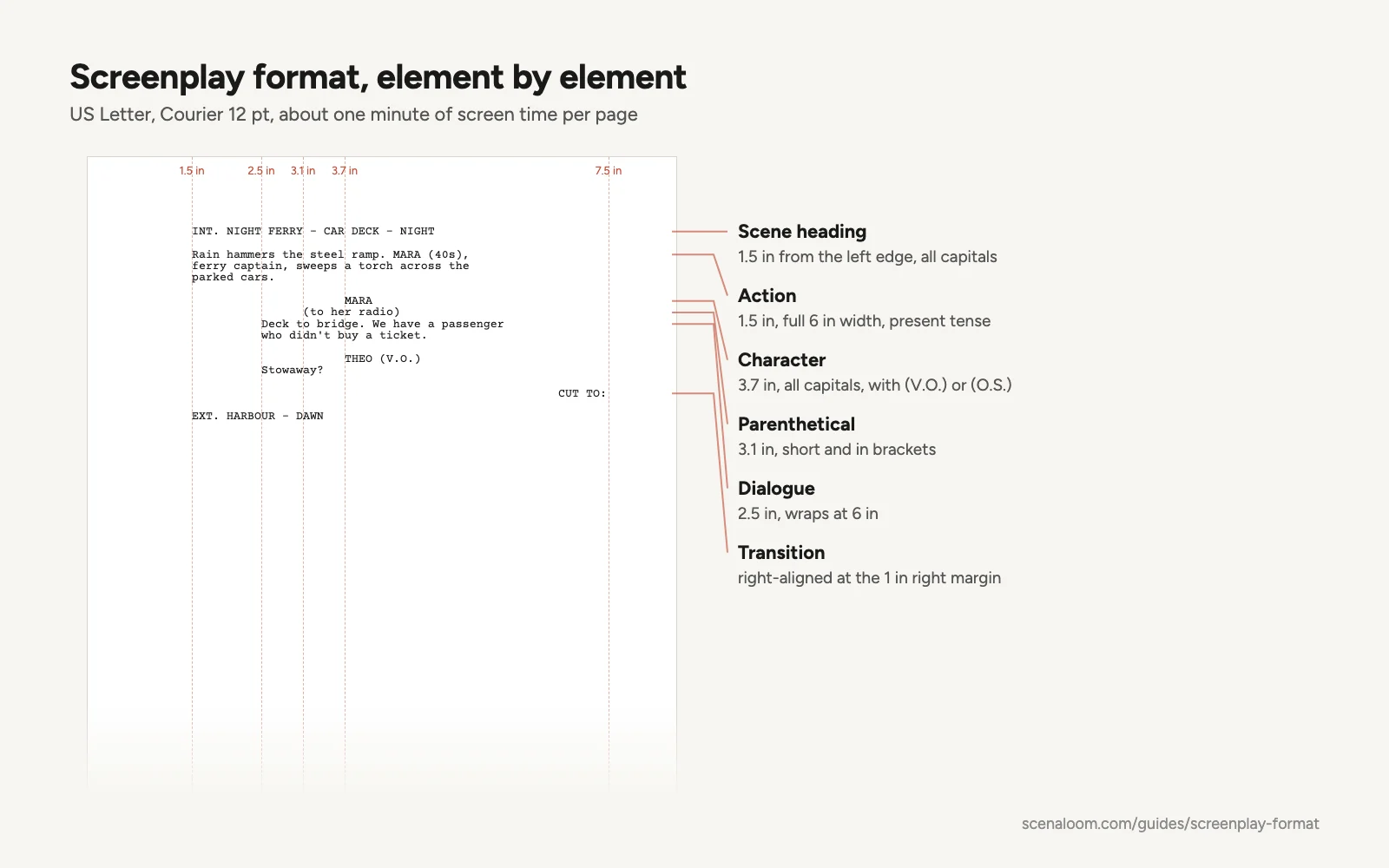
Every line of a script belongs to one of a handful of elements, and each element has its own left edge and its own casing rule. Positions below are measured from the left edge of the paper.
Scene heading (slugline)
Starts at 1.5 inches, all capitals: INT. or EXT., the location, a dash and the time of day — INT. LAUNDROMAT - NIGHT. Put one blank line before it and never leave it alone at the bottom of a page. The scene headings guide covers INT./EXT., CONTINUOUS and secondary headings.
Action
Also at 1.5 inches, running the full 6-inch width in ordinary sentence case and the present tense. Action describes only what the audience can see and hear. A speaking character's name goes in capitals the first time they appear, usually with an age. Keep paragraphs to about four lines; white space is what lets a page read fast.
Character cue
All capitals, starting 3.7 inches from the left edge — 22 characters in from the action margin. Extensions go in parentheses after the name: (V.O.) for voice-over, (O.S.) for someone present but out of frame, (CONT'D) when the same person keeps talking after a line of action.
MARA (V.O.)
Every night the same route.

DISPATCHER (O.S.)
Bus nine, you're running late.

Mara reaches for the radio.

MARA (CONT'D)
Bus nine copies.
Parenthetical
A short direction under the cue, lower case and in parentheses, starting 3.1 inches from the left and wrapping by 5.5 inches. Use it for who is being addressed, a small physical action or a tone the line cannot carry by itself — not to dictate every reading.
Dialogue
Starts 2.5 inches from the left and wraps at 6 inches, so a line of dialogue holds about 35 characters. That narrow column is why a page of talk reads quicker than a page of action.
Transition
All capitals, ending in a colon and right-aligned so it finishes at the right margin: CUT TO:, DISSOLVE TO:, SMASH CUT TO:. FADE IN: is the exception — it sits at the left margin at the very top of the script. Use transitions sparingly in a spec script; a new scene heading already implies a cut.
Shot
A camera direction such as CLOSE ON, ANGLE ON or INSERT, in capitals at the action margin. Shots belong mostly in shooting scripts. In a spec script, describe what we see and let the director choose the angle.
Spacing between elements
Script layout depends on blank lines as much as on indents. Put one blank line before every scene heading, action paragraph, character cue and transition. Inside a speech — cue, parenthetical, dialogue — there are no blank lines at all. Some writers add a second blank line before each scene heading; either way works as long as it is consistent through the whole draft.
An annotated example page
Here is a short original scene in correct screenwriting format, followed by notes on what each line is doing.
FADE IN:

INT. NIGHT BUS - MOVING - 2:40 A.M.

Strip lights flicker over empty seats. MARA OYELARAN (40s), driver's jacket zipped to the chin, watches her mirror. THEO (19) hugs a cardboard box.

MARA
End of the line's in two stops.

THEO
(not looking up)
I know where it ends.

Something inside the box scratches.

MARA
That better be a cat.

CUT TO:

EXT. RIVER DEPOT - CONTINUOUS
- FADE IN: opens the script at the left margin and appears only once.
- The scene heading names interior or exterior, the place and the time. MOVING is a common modifier for scenes inside vehicles.
- MARA and THEO are capitalized on their first appearance only, each with an age.
- (not looking up) is a parenthetical: lower case, on its own line, between the cue and the dialogue.
- CUT TO: sits flush right, and CONTINUOUS in the next heading tells the reader that no time has passed.
Page breaks: (MORE) and (CONT'D)
When a speech runs off the bottom of a page, it is split between sentences, never mid-sentence. The bottom of the page gets (MORE) at the cue position, and the next page repeats the cue with (CONT'D). Keep at least two lines of the speech on each side of the break. In the Fountain sample below, === marks where one page ends and the next begins.
THEO
I asked the man at the depot. He
said the night route ends at the river.
(MORE)

===

THEO (CONT'D)
So why are we still driving?
Other page-break rules follow the same logic: a scene heading, shot or character cue should never be the last line on a page, and a transition should never be the first. Older shooting scripts also printed CONTINUED: at the top and bottom of pages where a scene broke; most spec scripts leave that out today.
Scene numbers
Scene numbers belong to shooting scripts. They sit in both margins beside each scene heading so the crew can schedule "scene 42". Once a production starts, the numbers are locked: a new scene added between 5 and 6 becomes 5A, and a cut scene stays in place marked OMITTED so nothing else renumbers. Leave scene numbers off a spec script.
How long is a page of a script?
One correctly formatted screenplay page runs roughly one minute of screen time. That is why the font and margins are so rigid — change them and the page count stops meaning anything. It is a rule of thumb rather than a law, since a page of quick dialogue plays faster than a page describing a chase, but averaged across a draft it holds well enough that a 100-page feature is expected to run about 100 minutes. Features usually land between 90 and 120 pages; an hour-long TV drama runs roughly 50 to 65.
Spec script vs shooting script
A spec script is written to sell or to get you hired; a shooting script is the production's working document. The film script format is the same in both, but the extras differ:
- Spec script: no scene numbers, few camera directions, no revision marks and no draft date on the title page.
- Shooting script: scene numbers on both sides, shots and inserts where the director wants them, asterisks in the right margin beside revised lines, colored revision pages and locked pages numbered 12A, 12B.
Common screenplay format mistakes
- Directing the camera in a spec script. "We see" and "the camera pans" pull the reader out of the story; write what happens instead.
- Dialogue that runs the full width of the page. The script will look half as long as it plays.
- Action paragraphs of eight lines or more. Break them where the shot would change.
- Capitals everywhere. Keep them for scene headings, cues, transitions, first appearances and the occasional key sound.
- A scene heading or character cue stranded at the bottom of a page.
- A parenthetical on every speech telling the actor what to feel.
- Shrinking the font or margins to hit a page count. Readers notice, and the page-per-minute rule stops working.
Montages, flashbacks and intercuts have conventions of their own, covered in the montage and flashback guide.
Write it in Scenaloom
Scenaloom's screenplay editor applies the rules on this page as you type: Courier Prime 12 on US Letter, the element indents and blank lines, (MORE) and (CONT'D) at page breaks and scene numbers you can switch on and lock. Enter and Tab move you between elements, and the PDF export uses the same layout as the editor, so a page on screen is a page on paper. Start a script and the format takes care of itself.
Already written your script in plain text? Paste it into the free screenplay formatter to see it in this format and save it as a PDF or Final Draft file.
Questions
What is the standard screenplay format?
Standard screenplay format is 12-point Courier on US Letter paper with a 1.5-inch left margin, 1-inch right, top and bottom margins and about 55 lines per page. Scene headings and action run full width, character cues sit 3.7 inches from the left edge, dialogue runs from 2.5 to 6 inches and transitions are right-aligned. Page numbers go top right from page 2.
What are the margins for a screenplay?
A screenplay has a 1.5-inch left margin and roughly 1-inch margins at the right, top and bottom of a US Letter page. The wide left margin leaves room for the brads that bind a printed script. Inside that frame, dialogue is indented to 2.5 inches and character cues to 3.7 inches from the left edge of the paper.
How many pages is a movie script?
A feature film script usually runs between 90 and 120 pages, because one formatted page plays for roughly one minute of screen time. Comedies and horror films often sit near the shorter end and dramas near the longer end. A first spec script that comes in well over 120 pages is a common reason for readers to pass.
Do you put scene numbers in a spec script?
No — scene numbers belong in shooting scripts, not spec scripts. They are added when a production starts scheduling, and from then on they are locked so new scenes become 5A or 5B and cut scenes are marked OMITTED. In a script you are sending out to sell or to get work, leave them off.
Can I format a screenplay in Word or Google Docs?
You can format a screenplay in a word processor with paragraph styles for each element, but you have to manage page breaks, (MORE) and (CONT'D) and scene numbers by hand. Dedicated screenwriting software does those for you. Scenaloom formats as you type in the browser and can export a Word (.docx) copy when someone needs one — see Scenaloom's screenplay template.