
A story outline is a short, ordered list of what happens in a story — scene by scene, sequence by sequence or chapter by chapter — written before or alongside the draft so the writer can test the structure before committing pages to it. A plot outline is the same thing; the name just stresses the chain of events.
Below are copyable outline templates for a feature screenplay and for a novel, a filled example and the choices that shape a useful outline. If you have not settled the shape of the story yet, start with a beat sheet or the three-act structure and come back; an outline fills in what a beat sheet only marks.
What should a story outline include?
A story outline should include every scene or chapter in order, with where it happens, who is in it, what changes by the end of it and why the next unit follows. That last point is the one most outlines skip, and it is the one that finds structural problems.
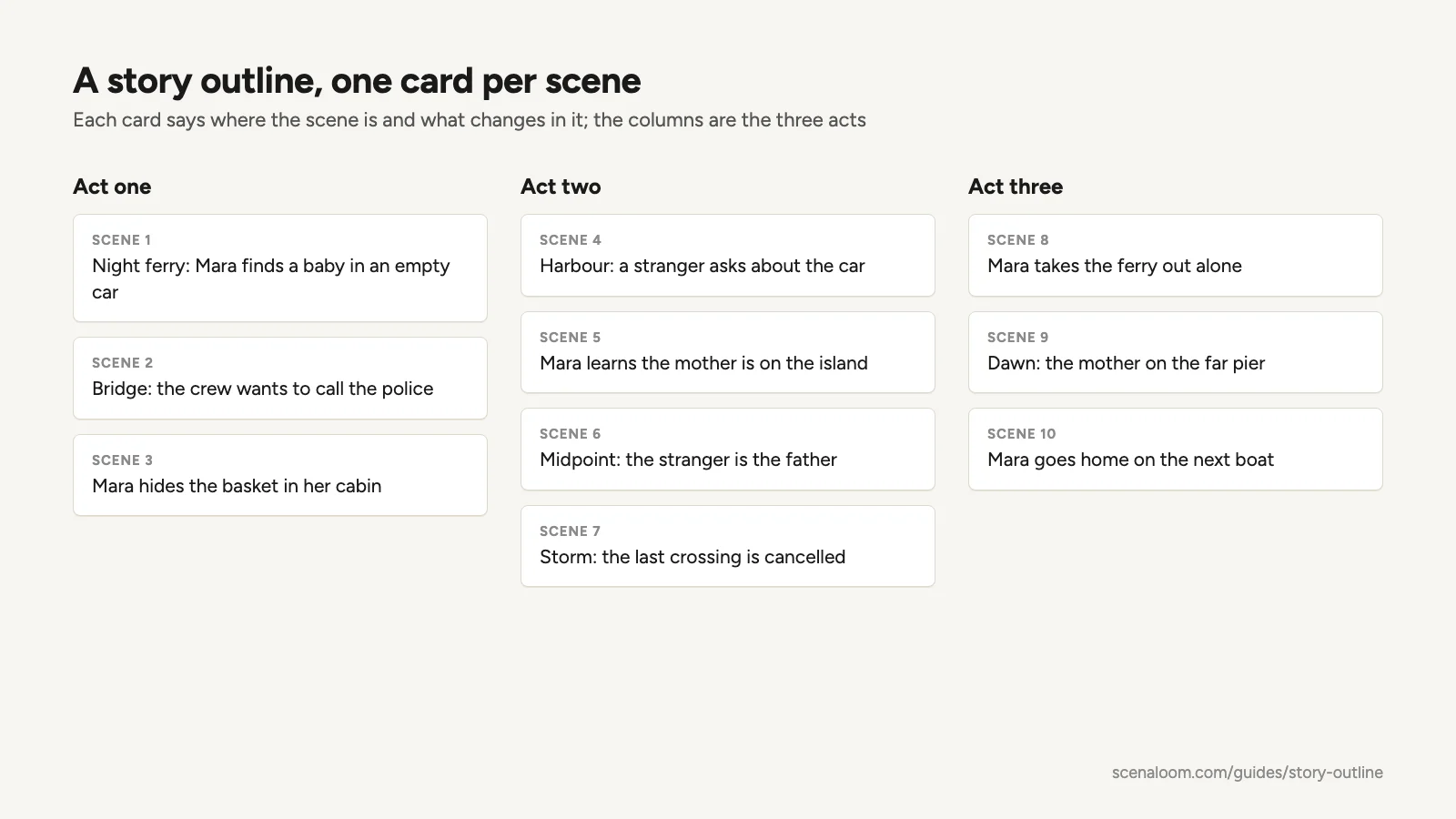
An outline is not a synopsis, which is prose written for a reader, or a film treatment, which sells the story's feel. It is a working tool. Short fragments, arrows and question marks are fine.
Scene-by-scene vs sequence outlines
A scene-by-scene outline gives one line or short paragraph to every scene. It is the closest thing to the finished script and the most useful just before drafting, but on a feature it runs to 40–70 entries and can hide the big shape.
A sequence outline groups scenes into eight or so sequences of roughly 10–15 pages each, each with its own goal and turn. It is easier to see the whole film in one screen and to move blocks around. Many writers outline in sequences first and break each sequence into scenes when they are ready to write it.
Novelists face the same choice between a chapter-by-chapter outline and an outline by parts or acts. The rule is the same: outline coarse while the story is still moving, fine once it has settled.
Screenplay outline template
Copy this template for a feature. Each sequence gets the fields below; fill the sequence line first, then the scenes.
- Title, logline and target length (for example, 100 pages). Write the logline before the outline.
- Sequence number and name: a label you will recognize, such as "Sequence 3: The audition".
- Rough page range: where the sequence should fall in the target length.
- Sequence goal: what the protagonist is trying to do in this stretch.
- Turn: how the sequence ends differently from how it began.
- Scenes: one line each, with the scene heading, who is there, what happens and what changes.
- Open questions: what you do not know yet. Leave them visible.
For a script outline at scene level, the line format looks like this:
INT. RECORD SHOP - DAY
DEV asks ALMA for his old job back. She says no — then hands him a broom.
Change: Dev is back in the shop, on probation.

EXT. RECORD SHOP ROOF - NIGHT
Dev finds Alma's demo tapes in a box marked BURN.
Change: he knows she used to sing. She doesn't know he knows.
A filled outline example
Here is the first act of an original feature, outlined by sequence and scene. The film is about a disgraced session musician who takes a job at a failing record shop.
Sequence 1: Last session (pages 1–12)
- Studio, night. Dev is fired mid-take for showing up drunk. Change: no work, no money.
- Dev's flat, morning. Eviction notice. He sells his last guitar. Change: nothing left to sell.
- Record shop, day. He asks Alma, his old boss, for work. She refuses, then hands him a broom. Change: a foothold.
Sequence 2: Probation (pages 12–25)
- Shop, week montage. Dev is useless at the till, brilliant with customers. Change: Alma notices.
- Roof, night. Dev finds tapes marked BURN — Alma singing, years ago. Change: he knows her secret.
- Shop, day. The landlord gives Alma sixty days to pay the arrears or close. Change: the clock starts. End of act one.
Each entry is a sentence or two, and each ends with what changed. When an entry has no change, the scene is a candidate for cutting or combining.
Novel outline template
A novel outline template works chapter by chapter. Copy these fields for each chapter:
- Chapter number and working title.
- Point of view: whose eyes the chapter is told through, if the book has more than one.
- Where and when: place and the time since the previous chapter.
- What happens: the events, in three to six short beats.
- What changes: for the plot and for the point-of-view character.
- Ending hook: the question or image that pulls the reader into the next chapter.
- Threads: subplots, clues or setups this chapter touches, so you can check each one pays off.
Above the chapter list, keep a one-page summary of the whole book: premise, main character's want and need, the main turning points and the ending. Below it, keep a running list of threads with the chapter where each is set up and where it is resolved.
Outlining a TV episode
A television episode outline works like a feature outline at a smaller scale, organized by acts instead of sequences. Each act ends on a turn strong enough to hold the audience across a break, and the outline tracks every story line — A, B and sometimes C — so you can see where each one advances. A one-hour drama outline is usually a few pages; a half-hour comedy outline is shorter. For a series, keep a separate one-paragraph outline per episode so the season's arc is visible at a glance.
Ways to outline a story
There is no single outline format. Writers choose by how much they want to know before drafting:
- Index cards or a beat board: one card per scene, laid out by act so you can move them. Good for seeing structure at a glance.
- Sequence outline: the story split into eight or so sequences of a few scenes each, each with its own small goal and turn. Good for long second acts.
- Scene-by-scene outline: one line or paragraph per scene in order, the most common screenplay outline.
- Treatment: the whole story in present-tense prose, two to a dozen pages, readable by people who will not read a script. See the film treatment guide.
- Snowflake method: start with one sentence, expand it to a paragraph, then to a page, then to scenes — popular with novelists.
- One-page grid: a single sheet with the story's genre, beginning, middle and end, used to check the whole shape before detail.
Pros and cons of outlining
Outlining makes the first draft faster and the story sounder: structural problems are cheaper to fix in a one-line scene list than in 30 written pages, and an outline is what lets you write out of order or with a partner. The cost is that some writers lose the energy of discovery once they know the ending, and a rigid outline can make characters serve the plot. A practical middle path is to outline the turns — inciting incident, act breaks, midpoint, climax — and discover the scenes between them as you write.
How to write a story outline, step by step
- Write the ending first, in one sentence. Every unit in the outline should move toward it.
- Mark the main turning points: the inciting incident, the act breaks, the midpoint, the climax.
- Fill sequences or parts between them, each with a goal and a turn.
- Break the first sequence or part into scenes or chapters. Leave the rest coarse for now.
- Draft, then update the outline when the draft changes the story. An outline that no longer matches the pages is worse than none.
Write it in Scenaloom
Scenaloom keeps a rich-text outline for each screenplay episode, and a beats board that can start from a three-act structure, a fifteen-beat sheet or a hero's journey, with each beat placed at its usual share of your target length. Novel projects have a global outline, a chapter board and an outline for every chapter, and Scenaloom AI can draft a chapter outline as a proposal you choose to use or add below your own. See story structure or start a project.
Questions
What is a story outline?
A story outline is an ordered list of the scenes, sequences or chapters of a story, each with what happens and what changes, written to test the structure before or during drafting. It is a private working document, shorter and rougher than a synopsis or a treatment.
What is the difference between a plot outline and a story outline?
In practice the two terms mean the same document. "Plot outline" puts the emphasis on the chain of events and causes, while "story outline" is sometimes used more loosely to include character arcs and themes. Both list the story's units in order with what happens in each.
How long should a screenplay outline be?
A screenplay outline for a feature usually runs from two to fifteen pages. A sequence outline of eight or so blocks fits on two or three pages; a full scene-by-scene outline with a line or two per scene often reaches ten pages or more. Length matters less than whether every entry says what changes.
Should I outline a novel chapter by chapter?
Outline a novel chapter by chapter once its main turning points are settled. Before that, an outline by parts or acts is easier to rearrange. Many novelists outline the next few chapters in detail and keep the rest at a coarser level, updating the plan as the draft teaches them more.
Can I write a screenplay without an outline?
Yes, and some writers discover the story by drafting. The cost is usually more rewriting, because structural problems surface late. A short outline of the main turning points is a cheap middle path; the beat sheet guide shows one way to make it.