A beat sheet is a short list of the turning points in a story — the moments where the direction changes — written in order and placed at roughly where each falls in the script. It sits between a logline and an outline: longer than one sentence, much shorter than a scene list, and the quickest way to see whether a story has a working shape.
Writers use beat sheets to plan a draft, to diagnose one that sags, and to pitch a story in a few minutes. The three most common templates are the three-act structure, the fifteen-beat Save the Cat beat sheet and the hero's journey. They describe the same underlying shape at different levels of detail.
What is a beat in screenwriting?
A beat in screenwriting is a single change in the story — a decision, discovery or reversal after which things cannot go back to how they were. The word is used at two scales. In a beat sheet, a beat is a major story turn such as the inciting incident or the midpoint. Inside a scene, a beat is a small shift in a character's tactic, and "(beat)" in a script marks a pause.
The three-act structure
The three-act structure divides a story into setup, confrontation and resolution, in proportions of roughly a quarter, a half and a quarter. It is the oldest and loosest of the three templates, and most other templates are subdivisions of it.
- Act one (about the first 25%): the protagonist's normal life, the inciting incident that disrupts it and the decision to act. It ends when the hero commits and cannot easily turn back.
- Act two (about 25% to 75%): rising obstacles, a midpoint that raises the stakes or changes the goal, and a slide toward the lowest point.
- Act three (about the last 25%): the protagonist uses what they have learned, faces the climax and the story settles into a new normal.
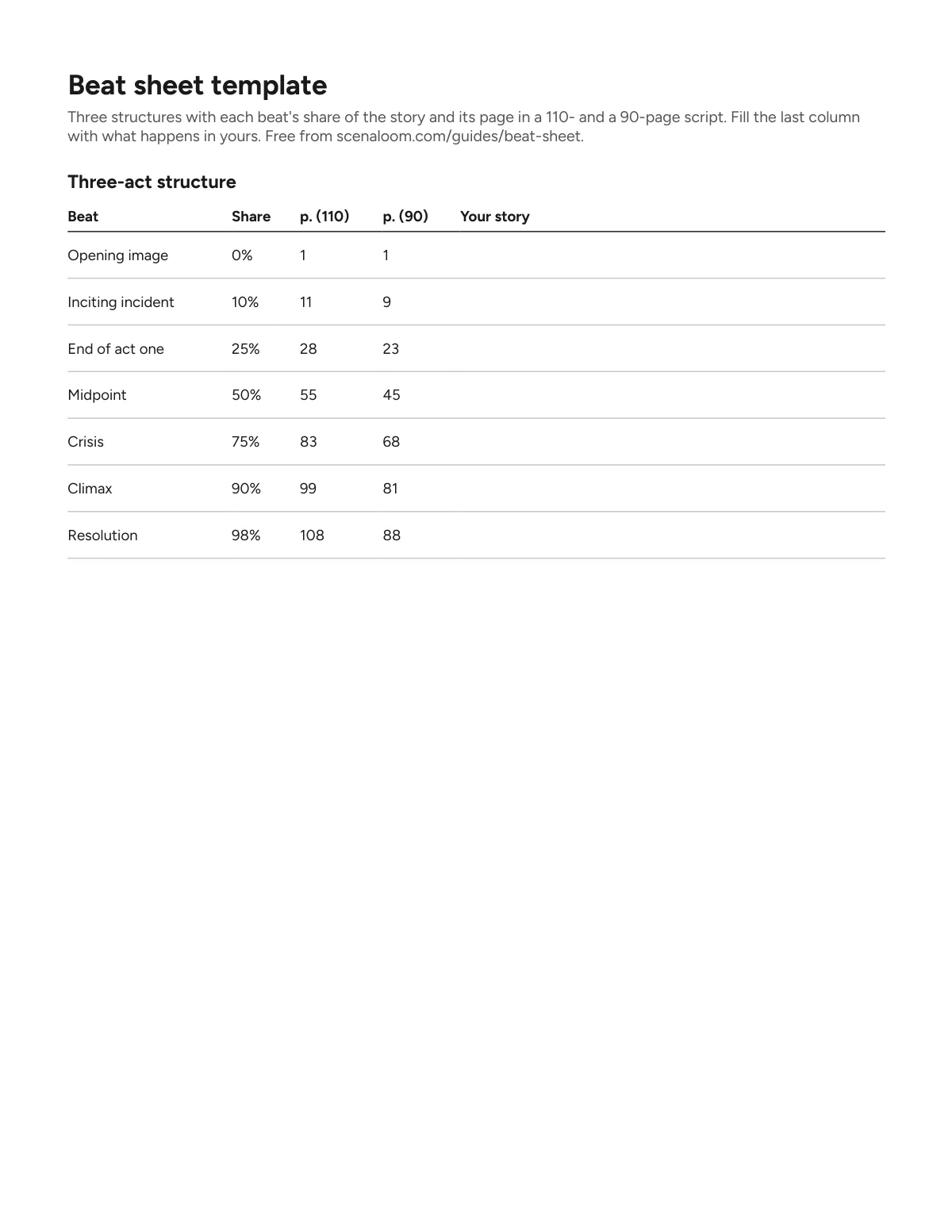
On a 110-page feature, that puts the end of act one near page 27, the midpoint near page 55 and the start of act three near page 82. Treat those as landmarks, not deadlines; many good films move a few pages either way.
Fifteen beats: the Save the Cat! model
This version breaks the three acts into fifteen named moments. The best-known version comes from Blake Snyder's 2005 book Save the Cat!, which is why many writers call it the Save the Cat beat sheet. The book is worth reading for his own explanations; below is our summary of the shape in our own words.
- An opening image that shows the hero's world and problem before anything changes.
- A hint of the theme — often a line spoken to the hero that they are not ready to hear.
- The setup: the hero's life, flaws and what is missing.
- The catalyst, around 10% in: the event that knocks the hero's life off balance.
- A debate in which the hero resists or questions the call.
- The move into act two, around 20–25%: the hero chooses to enter a new situation.
- A secondary story, often a relationship, that carries the theme.
- The "promise of the premise" stretch, where the story delivers what the logline promised.
- The midpoint at 50%: a false victory or false defeat that raises the stakes.
- Pressure building from outside and inside as the hero's plan frays.
- The low point, around 75%, where something important is lost.
- The hero's reaction to that loss — the darkest stretch before a new idea.
- The move into act three, when the A and B stories combine into a solution.
- The finale, where the hero applies what they have learned.
- A closing image that mirrors the opening one and shows how much has changed.
The strength of this template is its specificity: it tells you what kind of event belongs where. Its weakness is the same specificity — followed too literally, it produces stories that feel assembled from a kit.
Beat sheet template and page targets
Each beat's usual place, as a share of the story and as a page in a 110-page and a 90-page script. The positions are conventions, not rules; use them to see which beats drift, not to force a scene onto a page.
| Beat | Share | Page (110) | Page (90) |
|---|---|---|---|
| Opening image | 0% | 1 | 1 |
| Theme stated | 5% | 6 | 5 |
| Setup | 6% | 7 | 5 |
| Catalyst | 10% | 11 | 9 |
| Debate | 12% | 13 | 11 |
| Break into act two | 20% | 22 | 18 |
| B story | 22% | 24 | 20 |
| Fun and games | 27% | 30 | 24 |
| Midpoint | 50% | 55 | 45 |
| Bad guys close in | 55% | 61 | 50 |
| All is lost | 68% | 75 | 61 |
| Dark night of the soul | 70% | 77 | 63 |
| Break into act three | 77% | 85 | 69 |
| Finale | 80% | 88 | 72 |
| Final image | 99% | 109 | 89 |
Beat sheet template (CSV)The same three structures for Google Sheets, Excel or Numbers
The ten story types in the Save the Cat! method
Snyder's book also sorts films into ten story types by their engine rather than their setting: Monster in the House, Golden Fleece, Out of the Bottle, Dude with a Problem, Rites of Passage, Buddy Love, Whydunit, Fool Triumphant, Institutionalized and Superhero. The point of the list is comparison: once you know which kind of story you are telling, you can study others of the same kind for how they handled the same beats.
The hero's journey
The hero's journey is a pattern of departure, ordeal and return that Joseph Campbell described in The Hero with a Thousand Faces (1949) from myths across cultures. Christopher Vogler later adapted it for screenwriters in The Writer's Journey as twelve stages: the ordinary world, the call to adventure, refusal of the call, meeting the mentor, crossing the threshold, tests, allies and enemies, approach to the inmost cave, the ordeal, the reward, the road back, the resurrection and the return with the elixir.
The hero's journey suits quests, fantasy, adventure and coming-of-age stories, where a character physically or symbolically leaves home. It fits less naturally with ensemble pieces or stories whose protagonist does not change.
Three-act vs fifteen beats vs hero's journey
- Use the three-act structure when you want the lightest frame — for early development, short films or a story you already feel intuitively.
- Use fifteen beats when the middle sags or you want to check pacing page by page in a commercial feature.
- Use the hero's journey when the story is about transformation through a journey, and when mentor, threshold and ordeal figures help you populate the world.
They are not rivals. Many writers rough out three acts, then use a more detailed sheet to fill in act two.
How to write a beat sheet
- Write your logline first. If you cannot, the beats will expose the gap — see the logline guide.
- Fix the ending before the middle. Knowing the climax tells you what the hero must learn, and that tells you what the midpoint has to set up.
- Fill in the act breaks and the midpoint, then the inciting incident and low point.
- Write each beat as an event with a consequence ("Mara takes the money, so now she is complicit"), not as a mood.
- Check positions against your target length and move beats that drift far from their usual place.
- Expand each beat into the scenes needed to get there. That list is your outline.
Beat sheet example
Here is a short three-act beat sheet for a feature built from Last Call, the cold-open example in our Screenplay Museum, where a young man brings a diner owner a bag of cash from his dead father:
- Opening: Mara runs an all-night diner and keeps everyone, including herself, at arm's length.
- Inciting incident: Jonas arrives with a bag of money his father, dead six years, apparently sent.
- End of act one: headlights outside; Mara hides Jonas instead of calling the police and is now part of it.
- Midpoint: they learn the father faked his death — and someone else knows.
- Low point: the people hunting the money take the diner, the one thing Mara would not risk.
- Climax: Mara uses what she knows about her old friend to trade the money for Jonas's freedom.
- Closing: the diner reopens; Mara pours a second coffee and sits down with someone.
Write it in Scenaloom
Scenaloom's beats board can start from a three-act structure, fifteen beats or a hero's journey, with each beat placed at its usual share of your target length (110 pages by default). The story map marks pages that run past the target, and beats and outlines export alongside the draft. Read how it works in the outline and beats docs or start a project.
To find the page for each beat in a script of your own length, use the free beat sheet calculator.
Questions
What is a Save the Cat beat sheet?
A Save the Cat beat sheet is the fifteen-beat story template popularized by Blake Snyder's 2005 screenwriting book Save the Cat!. It divides a feature into fifteen turning points, from the opening image to the final image, each placed at an approximate page. Writers use it to plan pacing and to find where a draft's middle loses momentum.
How many beats are in a beat sheet?
A beat sheet has as many beats as the template you choose: three-act outlines often name five to eight key turns, the popular fifteen-beat model has fifteen, and the hero's journey has twelve stages in Christopher Vogler's version. There is no correct number; the test is whether each beat changes the story's direction.
Is a beat sheet the same as an outline?
No. A beat sheet lists only the major turning points, usually on one page. An outline lists every scene in order and often runs several pages. Most writers build the beats first, then expand each beat into the scenes that get the story there.
Does every movie follow the three-act structure?
Not strictly. Many films can be described in three acts after the fact, but plenty use five acts, nonlinear timelines or episodic shapes. Treat three acts as a diagnostic tool for finding where a story turns, not as a rule every script must obey.
Where should the midpoint fall in a screenplay?
The midpoint usually falls near the middle of the script — around page 55 of a 110-page feature. It is a turn that raises the stakes or changes what the protagonist wants, often a false victory or false defeat. A midpoint that arrives much later tends to leave the first half of act two without direction.