
The three-act structure divides a story into a setup, a confrontation and a resolution, joined by two turning points that push the protagonist into a new situation. In a feature screenplay the acts run in proportions of roughly 25%, 50% and 25%, with a midpoint halfway through the second act.
The idea of a beginning, middle and end goes back to Aristotle's Poetics, but the version screenwriters use today was popularized by Syd Field's book Screenplay (1979), which gave the turns between acts the name "plot points". It remains the common language of film development: when a producer asks where act two starts, they are using this model.
The 3 act structure as a diagram
On a 110-page feature, where one page is roughly one minute of screen time, the three-act structure maps out like this. Treat the page numbers as landmarks, not deadlines.
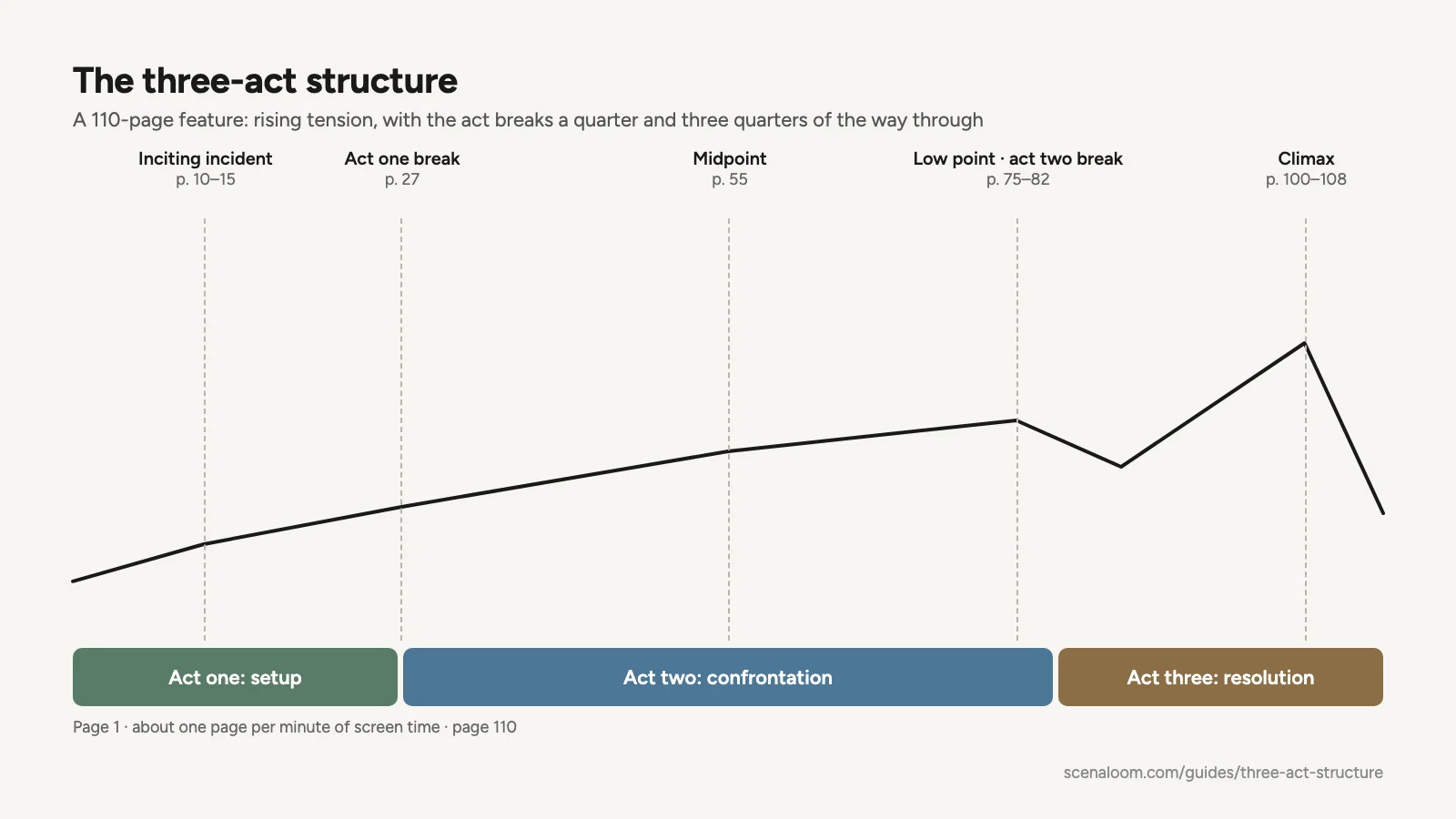
- Pages 1–10: the opening and setup — who the protagonist is, what they want and what is wrong.
- Around pages 10–15: the inciting incident that disrupts their normal life.
- Around page 27 (25%): the first act break — the protagonist commits to a course of action and enters act two.
- Around page 55 (50%): the midpoint — a reversal, revelation or false victory that raises the stakes.
- Around pages 75–82: the low point and the second act break — everything seems lost, then a new decision launches act three.
- Around pages 100–108: the climax — the protagonist faces the central conflict directly.
- The final pages: the resolution — the new normal, showing what has changed.
Act one: the setup
Act one establishes the protagonist, their world and the problem that will drive the story, and ends when they commit to a goal they cannot easily abandon. Its job is to make the audience care about someone before anything happens to them, then make something happen.
Most first acts contain three things: an ordinary world shown in a way that hints at what is missing, an inciting incident that upsets it, and a period of resistance or preparation that ends with a choice. The choice matters. An act break that simply happens to the hero is weaker than one the hero decides to step through.
Act two: the confrontation
Act two is the longest act, in which the protagonist pursues the goal against rising obstacles and is forced to change to succeed. It covers roughly half the script — about 55 pages of a 110-page feature — which is why it is where most drafts lose momentum.
Act two usually has three movements. First the protagonist tries the new situation with their old habits and gets mixed results. Then the midpoint changes the game. Then pressure builds from outside and inside until the plan collapses at the low point. If your second act feels flat, check that the protagonist's tactics change at least twice; repeating the same attempt with bigger obstacles is not escalation.
The midpoint
The midpoint is a turning point in the middle of act two that raises the stakes or changes the nature of the goal. It is often a false victory (the hero gets what they wanted and it is not enough) or a false defeat (an apparent loss that reveals the real problem). A good midpoint splits act two into two halves that feel different: before it the protagonist is reacting, after it they are driving.
Act three: the resolution
Act three is the final quarter, in which the protagonist uses what they have learned to face the central conflict and the story settles into a new normal. It starts with a decision made at or just after the lowest point, builds to the climax and ends with a brief resolution that shows the cost and the change.
The strongest third acts pay off something planted in act one: a skill, a flaw, a line of dialogue, an object. If the climax could be solved by a character the audience met in act three, or by luck, the structure is doing less work than it should.
What makes an act break work?
An act break works when it turns the story in a direction that cannot be reversed and gives the next act a new question to answer. Three tests help when you are deciding where your act breaks fall:
- Irreversibility: after the break, the protagonist cannot return to how things were — a door locks, a secret is out, a promise is made.
- A new question: act one asks "will they take this on?"; act two asks "can they win?"; act three asks "what will it cost?" Each break should swap one question for the next.
- Choice: the strongest breaks are decisions, not accidents. Even when an event forces the turn, show the character choosing how to respond.
In television the term is used more literally: an act break is the point where a commercial break falls, and network hours are often built in four to six short acts, each ending on a hook. Our TV pilot guide covers that shape.
Three act structure examples
Here is how two widely seen films divide into three acts, described in our own words. Running times differ, so the proportions matter more than the minute marks.
The Wizard of Oz (1939)
- Act one: Dorothy feels unheard on the farm in Kansas; a neighbor tries to take her dog away; she runs off, and a tornado carries the house to Oz. The act ends as she sets out down the yellow brick road with a clear goal: reach the wizard and get home.
- Act two: she gathers three companions, each wanting something they believe they lack. At the midpoint they reach the Emerald City and the wizard changes the goal: bring back the Wicked Witch's broomstick first. The low point comes when Dorothy is captured and watches time running out.
- Act three: her friends rescue her, the witch is defeated, the wizard is exposed as an ordinary man, and Dorothy learns she had the means to go home all along.
Toy Story (1995)
- Act one: Woody is the favorite toy until a new space-ranger toy, Buzz, arrives and takes his place. Woody's jealous scheme ends with both of them lost outside the house — the act break.
- Act two: the two must work together to get back. Around the midpoint Buzz sees a television commercial and learns he is a toy, not a real space ranger, which turns the story from an escape into a crisis of identity. The low point finds both stuck in a neighbor's house with the family about to move.
- Act three: Woody restores Buzz's sense of purpose, and the two chase the moving van in a climax that only works because they finally cooperate.
Notice that in both films the midpoint changes the goal rather than just adding an obstacle, and the climax is won with something the protagonist learned in act two.
Common three-act problems and fixes
- Act one runs long: if the inciting incident lands after page 15 on a feature, cut setup scenes that repeat what the audience already knows about the hero.
- Act two sags: split it into two halves around a real midpoint, or into four sequences, each with its own small goal.
- The climax is passive: make sure the protagonist, not a rescuer or coincidence, causes the outcome.
- The ending is abrupt: give the resolution a scene or two that shows the new normal and mirrors the opening.
For finer control, a beat sheet divides the same three acts into fifteen named beats, and the wider story structure guide compares three acts with five-act, kishōtenketsu and nonlinear models.
Where the three-act structure comes from
The idea that a story has a beginning, a middle and an end goes back to Aristotle's Poetics, written around 335 BC, which argued that a tragedy should be a complete action whose parts follow from one another. The screenwriting version came much later. Syd Field's 1979 book Screenplay described a paradigm of setup, confrontation and resolution, divided by two plot points: one near the end of the first quarter that spins the story into act two, and one near the end of act two that spins it into the climax. Later writers added the midpoint as the hinge of the long second act.
When to use the three-act structure
Use it as a diagnostic rather than a mould. It is most useful for feature films and single-story novels with one protagonist and one central goal, where a sagging middle or a late inciting incident is easy to spot against the usual proportions. It fits less neatly to ensemble stories, episodic television, where a series runs on four- to six-act episodes, and to stories built on mood or repetition rather than escalation. If your story does not want three acts, look at the story circle or a fifteen-beat sheet to see whether a finer or a different frame helps.
Three-act structure on stage, page and screen
- Film: the acts are proportions of screen time, roughly 25%, 50% and 25%, and audiences feel a late act break as a slow start.
- Television: a broadcast hour is cut into four to six acts around commercial breaks, each ending on a turn; streaming episodes keep the turns without the breaks.
- Stage: many plays still run in two or three acts with an interval, and the act curtain falls on a turn the audience carries out of the room.
- Novels: the same proportions apply to chapters instead of pages; the end of act one usually lands around a quarter of the way through the book.
Write it in Scenaloom
Scenaloom's beats board can start from a three-act structure, a fifteen-beat sheet or a hero's journey, with each beat placed at its usual share of your target length — 110 pages by default, so the first act break lands near page 27 and the midpoint near page 55 until you change it. The story map shows your target script length and marks pages that run past it in red, the outline keeps the plan for each episode and the scene board lets you move scenes between acts as cards. Read outline and beats or start a project.
Questions
What is the three-act structure?
The three-act structure is a way of dividing a story into setup, confrontation and resolution. Act one introduces the protagonist and ends with a commitment to a goal; act two tests that commitment with rising obstacles and a midpoint; act three resolves the central conflict in a climax. In a feature the acts run about 25%, 50% and 25% of the pages.
Where do the act breaks fall in a screenplay?
In a feature screenplay the first act break usually falls about a quarter of the way through — near page 27 of a 110-page script — and the second about three quarters through, near page 82. These are rules of thumb, not requirements; many good films move their breaks a few pages either way.
How long is each act in a 3 act structure?
Each act in a three-act structure is roughly 25%, 50% and 25% of the story. On a 110-page script, where a page is roughly a minute of screen time, that means about 27 pages for act one, 55 for act two and 28 for act three.
What happens at the midpoint of a screenplay?
The midpoint of a screenplay is a turning point halfway through that raises the stakes or changes the goal. It is often a false victory or a false defeat, and it moves the protagonist from reacting to acting. Without one, the second act tends to feel like the same attempt repeated with bigger obstacles.
Is the three-act structure the same as a beat sheet?
No. The three-act structure is the broad frame of setup, confrontation and resolution; a beat sheet lists the specific turning points inside that frame, such as the catalyst, midpoint and low point, each at an approximate page. A fifteen-beat sheet is essentially a detailed three-act structure.
Is the three-act structure universal?
No. It describes how many Western films and novels are paced, but stories built on four-act forms such as kishōtenketsu, on episodes, or on several protagonists turn in different places. It is a useful default for a feature with one hero and one goal, not a rule every story must follow.