A script breakdown is the process of reading a screenplay scene by scene and listing everything each scene needs to be filmed — cast, extras, props, locations, wardrobe, makeup, vehicles, effects and sound. The lists go onto one breakdown sheet per scene, which the assistant director and producer use to build the shooting schedule and budget.
This guide covers the element categories, how to mark up a scene, a copyable breakdown sheet and a filled example from an original scene. It assumes a finished, numbered script; if your scenes are not yet numbered, see scene headings first.
Who does a script breakdown, and when?
A script breakdown is usually done by the first assistant director or a production manager once the script is locked for preproduction. Heads of department then do their own, deeper breakdowns — the costume designer for wardrobe, the props master for props. On a short film, the writer-director often does all of it.
Writers benefit from a light breakdown too. Counting locations, speaking parts and night exteriors is the quickest way to see what a script will cost, which matters for a short film on a small budget.
The breakdown elements
Each production adapts the list, but these categories cover most scripts:
- Cast: speaking characters, listed by name and given a number used on the schedule.
- Extras and stand-ins: background people, with a count: "6 diners".
- Stunts: any action needing a stunt coordinator, even a fall or a fight.
- Props: objects a character handles or the story depends on.
- Set dressing: objects in the location nobody handles.
- Locations and sets: the place, with INT. or EXT. and DAY or NIGHT.
- Wardrobe: costumes, especially changes, damage or duplicates.
- Makeup and hair: wounds, ageing, wet looks, anything beyond a basic look.
- Vehicles and animals: anything that moves and needs a handler or driver.
- Special effects: rain, smoke, fire, breakaways: things done on set.
- Visual effects: things added after shooting.
- Sound and music: playback on set, a song a character sings, a sound the scene depends on.
- Special equipment: a crane, a car rig, underwater housing.
How to mark up a scene
- Number the scenes and lock the numbering, so a breakdown and a schedule always refer to the same scene.
- Measure each scene's length in eighths of a page. A full page is 8/8; a scene of a quarter-page is 2/8. Schedules use eighths to estimate shooting time.
- Read the scene once for story, then again with a pencil or highlighter. Underline each element and mark its category, using one color per category or a short code such as CAST, PROP or SFX.
- Note things the text implies but does not say. Rain implies wet wardrobe and makeup; a character who arrives "breathless from the stairs" implies a stairwell.
- Copy every marked element onto that scene's breakdown sheet.
Script breakdown sheet template
Script breakdown sheet (PDF)One sheet per scene with a box for every element. Free, no sign-up
Script breakdown template (CSV)One row per scene, with a filled example row
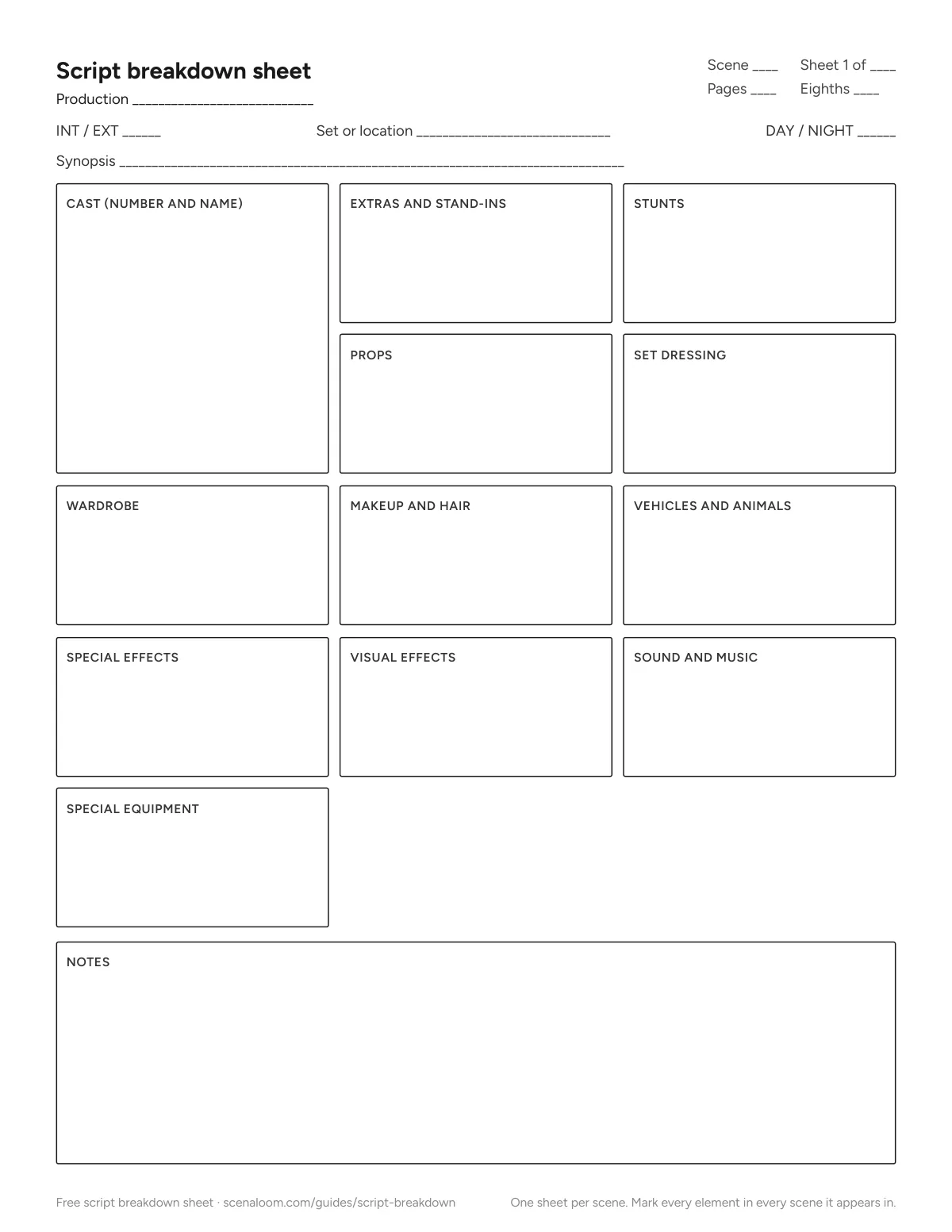
Copy these fields for each scene:
- Header: production title, scene number, sheet number, script page(s) and page count in eighths.
- Scene heading: INT./EXT., set or location name and DAY/NIGHT.
- Synopsis: one line on what happens.
- Cast: names with their cast numbers.
- Extras, stunts: with counts.
- Props, set dressing, wardrobe, makeup and hair.
- Vehicles and animals, special effects, visual effects, sound and music.
- Special equipment and notes.
A filled breakdown example
Here is a short original scene and the breakdown sheet for it.
EXT. CAR PARK ROOF - NIGHT

Rain. A battered hatchback, engine running. TESS (30s) in the driver's seat, a bandage on her hand.

DANNY (30s) climbs in, soaked, a sports bag on his knees.

DANNY
Drive.

TESS
Is that all of it?

He unzips the bag. Bundled cash — and a pistol. She stares.

A security guard's FLASHLIGHT sweeps the far ramp. Tess kills the headlights.
- Scene 23: Ext. car park roof — Night — 3/8 page.
- Synopsis: Danny joins Tess in the car with the stolen money; she sees the gun.
- Cast: 1. Tess, 2. Danny.
- Extras: 1 security guard (silhouette, flashlight).
- Props: sports bag, bundled cash, pistol (non-firing replica), flashlight, car keys.
- Wardrobe: Danny: wet; duplicate costume needed for multiple takes.
- Makeup: Tess: bandaged hand (continuity from scene 19); Danny — wet hair.
- Vehicles: battered hatchback with working headlights; picture-car driver for positioning.
- Special effects: rain on a rooftop exterior at night.
- Notes: weapon on set needs an armorer or props safety protocol.
A scene of under half a page needs rain, a picture car, a weapon replica and a duplicate costume — the kind of finding that changes a schedule. Breakdowns turn reading into a list someone can price. Done for every scene, they also show which locations, actors and effects repeat, which is where most scheduling savings come from.
Common script breakdown mistakes
- Breaking down a script that is still changing. If scene numbers change after the breakdown, every sheet and schedule strip has to be checked again.
- Listing only what is written. Implied needs — continuity wounds, wet clothes, a phone that must light up on cue — cost as much as stated ones.
- Missing continuity. A bandage, a torn sleeve or a half-eaten meal must match across scenes shot weeks apart; note the scene it continues from.
- Vague counts. "Some diners" cannot be booked; "6 diners, 2 waiters" can.
- Forgetting safety. Weapons, stunts, water, heights, vehicles and children each bring rules and people that must be planned and budgeted.
- Inconsistent names. If the script calls a character "Danny" in one scene and "Dan" in another, the breakdown may list two people. Fix the script first.
From breakdown to schedule
Once every scene has a sheet, the scenes are sorted onto a stripboard: one strip per scene, grouped by location, then by day or night and cast, so the crew shoots everything at one location together. The breakdown also feeds the budget, because every prop, extra and effect has a cost. A shot list then plans the camera setups inside each scene.
Write it in Scenaloom
Scenaloom builds character pages from the cues in your script and location pages from its scene headings, keeps a props list alongside them, and adds casting and scouting sheets for tracking who and where. The scene list is sortable, and scenes, casting, locations and props export as CSV sheets you can open in Excel or Google Sheets to finish a breakdown. Scenaloom does not tag wardrobe or effects in the script. See characters and entities or start a project.
Questions
What is a script breakdown?
A script breakdown is a scene-by-scene list of everything a screenplay needs to be filmed — cast, extras, props, locations, wardrobe, makeup, vehicles, effects and sound. It is recorded on breakdown sheets, one per scene, and used to build the shooting schedule and the budget.
How do you do a script breakdown?
Number and lock the scenes, measure each in eighths of a page, then read each scene and mark every element by category with a color or code. Copy the marked elements onto a breakdown sheet for that scene, including things the text implies, such as wet wardrobe in a rain scene.
What is a script breakdown sheet?
A script breakdown sheet is a one-page form for a single scene that lists its scene number, heading, page count in eighths, a one-line synopsis and every element it needs, grouped by category. The sheets together become the source for the stripboard and schedule.
What are eighths in a script breakdown?
Eighths are how productions measure scene length: each script page is divided into eight parts, so a half-page scene is 4/8 and a page and a quarter is 1 2/8. Schedules use the totals to estimate how much can be shot in a day.
Who does the script breakdown on a film?
The first assistant director or production manager usually does the master breakdown, and each department head does a detailed one for their area. On small productions and short films, the writer-director or producer often does it alone, sometimes in a single spreadsheet with one row per scene.