
A character arc is the inner change a character goes through over the course of a story — how their beliefs, values or behavior at the end differ from the beginning. Most arcs fall into three types: positive (the character grows), negative (the character falls) and flat (the character stays true and changes the world around them).
The arc is what makes a plot matter. The external story gives a character something to do; the arc shows what doing it costs them and what it makes of them. When audiences say they did not care about a film despite everything that happened in it, a missing arc is often the reason.
What is a character arc?
A character arc is the path between who a character is at the start of a story and who they are at the end, shaped by the pressure of the plot. Because that change is internal, a screenplay has to show it through choices: what the character does when doing it costs them something.
Most arc theory rests on one idea. The character begins with a mistaken belief about themselves or the world — writers call it the lie, the flaw or the wound. The plot puts that belief under pressure until the character must either let it go or hold on to it at great cost.
Want vs need
The want is what a character consciously pursues; the need is what they must recognize or change to be whole. The want drives the plot and the need drives the arc, and the two often pull in opposite directions.
- Want: external, specific and visible. Win the case, save the house, find the missing sister. It gives the story its goal and each scene its action.
- Need: internal and often unspoken. Learn to trust, accept a loss, stop performing for a parent's approval. The character usually does not know it at the start.
- The collision: the strongest arcs force a choice between want and need late in the story. A character who gets the want and ignores the need wins hollowly — or tragically.
Types of character arc
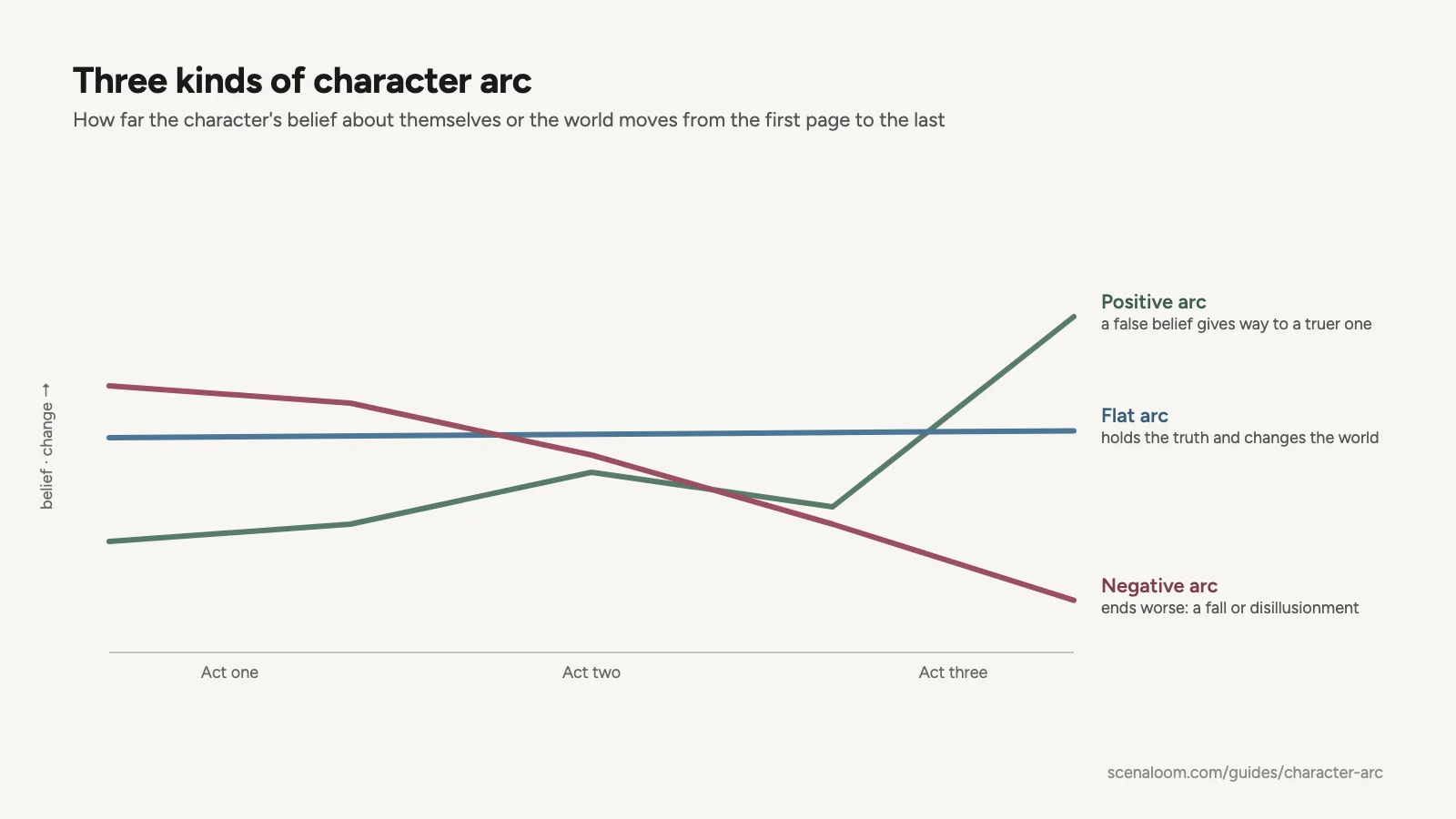
Positive arc
In a positive arc, the character starts with a flawed belief, is tested by the plot and ends by replacing it with a truer one. It is the most familiar shape in mainstream film: a selfish character learns generosity, a frightened one finds courage, a loner lets people in.
Negative arc
In a negative arc, the character ends worse than they began. Common variants are the fall, where a decent person is corrupted by pursuing the want; disillusionment, where they learn a hard truth and lose something in the learning; and refusal, where they are offered the truth, cling to the lie and are destroyed by it. Tragedies and many crime stories run on negative arcs.
Flat arc
In a flat arc, the protagonist already holds the truth and changes little; instead, they change the people and the world around them. Many detectives, mentors and heroes of long-running series have flat arcs. The change still happens — it moves through the supporting characters, who are tested by the protagonist's steadiness.
Supporting characters can carry arcs of their own, and an antagonist's arc often mirrors the hero's: two people facing the same pressure who choose differently.
Character arc beats mapped to the three acts
A character arc maps onto the three-act structure: act one establishes the flaw, act two tests it under rising pressure and act three forces the choice that proves whether the character has changed.
- Setup (act one): show the flaw in action in a small, specific scene, and let it cost the character something minor.
- Inciting incident: the plot arrives and aims straight at the flaw. See the inciting incident guide.
- First act break: the character commits to the want while still holding the old belief.
- First half of act two: the old belief mostly works, or seems to. Small wins hide the problem.
- Midpoint: a revelation or a false victory shows the character a glimpse of the need.
- Second half of act two: the old belief starts to fail and relationships strain.
- Low point: the old way of being leads to a real loss, and the character must face the lie.
- Climax (act three): under maximum pressure, the character makes a choice only the changed person would make — or, in a negative arc, only the unchanged one would.
- Final image: echo the opening scene so the audience can measure the difference.
Character arc example
Here is an original worked example. DANA RUIZ, 40, runs her late father's hardware store and does everything herself, because asking for help, she believes, means admitting she cannot cope. Her want: save the store from a chain store opening across the road. Her need: let other people in.
- Setup: Dana waves off a teenage customer who offers to help carry stock, then drops a box of nails across the floor.
- Inciting incident: the chain store's sign goes up, and within a month her takings fall by half.
- Act-one break: she decides to fight with longer hours and a loan she hides from her brother.
- Midpoint: the teenager, Leo, rebuilds the store's broken website overnight without being asked, and online orders start arriving. Dana is grateful — and furious that she needed it.
- Low point: exhausted, she misses a delivery and loses her biggest contractor account. Her brother finds out about the loan.
- Climax: at a neighborhood meeting about the store's future, Dana stands up and asks — out loud, for the first time — for help.
- Final image: Leo and her brother carry stock past her while she works the counter. A box drops. Nobody panics.
On the page, the turn can be small. The arc lives in what she says and what it costs her to say it:
INT. COMMUNITY HALL - NIGHT

Folding chairs, half full. DANA (40) stands at the front, holding notes she isn't reading.

DANA
I've run that store alone for six years. I've told everyone it's fine.
(beat)
It isn't. I need help. I don't know how to ask, so I'm just... asking.

Silence. In the back row, LEO (17) raises his hand.

LEO
I already did the website.

A laugh moves through the room. Dana laughs too, and doesn't wipe her eyes.
Change arcs and steadfast arcs
A clearer way to sort arcs is by who changes. In a change arc the protagonist changes: positively, by overcoming a flaw or a false belief, or negatively, by falling, being corrupted or losing their illusions. In a steadfast arc — often called a flat arc — the protagonist already holds the truth the story is about and does not change; instead they hold to it under pressure and change the people and the world around them. Both are real arcs, because both are tested.
- Positive change: the protagonist trades a false belief for a truer one and is better for it.
- Disillusionment: the protagonist learns a truth that costs them a comforting belief; they end wiser and sadder.
- Fall or corruption: the protagonist chooses the false belief, or something worse, and ends diminished.
- Steadfast: the protagonist does not change; the supporting cast and the world do, because of them.
Character arc vs narrative arc
The narrative arc, or story arc, is the shape of the plot — what happens, in which order, building to a climax. The character arc is the shape of the protagonist's inner change across those events. They should be built together: each major plot turn is a test that forces the character to act on their old belief or their new one, and the climax is the moment the plot and the character arc resolve in the same choice.
Several arcs in one story
Ensemble stories give several characters their own arcs, and even a single-hero story usually gives the most important supporting characters one. Keep them distinct: if two characters learn the same lesson, merge them or change one. A useful pattern is the mirror, where a supporting character faces the same choice as the protagonist and chooses the other way, showing what the protagonist's change is worth.
How to write a strong character arc
- Start from the end. Decide who the character is in the last scene, then design the first scene as its opposite.
- Make the flaw useful. A flaw that has protected the character for years is believable; one they would happily drop is not.
- Test it in action, not conversation. Characters who explain their growth sound like a therapy session; characters who choose differently under pressure show it.
- Give each act a different version of the same test, with higher stakes each time.
- Let a secondary character embody the alternative — someone who shows what the protagonist could become, for better or worse.
A character profile that records the want, need, flaw and wound before you outline lets you check every scene against them.
Write it in Scenaloom
Scenaloom's beats board can start from a three-act structure, a fifteen-beat sheet or a hero's journey, each beat placed at its usual share of your target length, so you can set arc beats beside plot beats. The characters page is built from the character cues in your script, and Worldview — the story bible — can hold each character's want, need and flaw as custom entries that Scenaloom AI reads when you ask it for help. Read about outline and beats or start a project.
Questions
What are the three types of character arc?
The three main types of character arc are positive, negative and flat. In a positive arc the character overcomes a flaw and grows; in a negative arc they fall, become disillusioned or refuse to change and pay for it; in a flat arc the character already holds the truth and changes the people and world around them instead.
Does every character need an arc?
No. The protagonist usually needs one, and important supporting characters benefit from small arcs, but minor characters can stay as they are. A flat-arc protagonist is also valid, as long as someone in the story changes because of them. What every story needs is change of some kind, somewhere.
What is the difference between want and need?
The want is the external goal a character consciously pursues, such as winning a case or saving a business. The need is the internal change they must make to be whole, such as learning to trust. The want drives the plot; the need drives the character arc, and the climax often forces a choice between them.
How do you show a character arc in a screenplay?
Show a character arc through choices rather than speeches. Establish the flaw in an early scene where it costs the character something, test it with rising pressure through act two and give the climax a choice only the changed character would make. Echoing the opening scene in the final image lets the audience see the difference.
What is a flat character arc?
A flat character arc belongs to a protagonist who begins the story already believing something true and holds on to it under pressure. Instead of changing themselves, they change the people and situation around them. Flat arcs are common for detectives, mentors and the leads of long-running series, where the supporting cast carries the visible change.